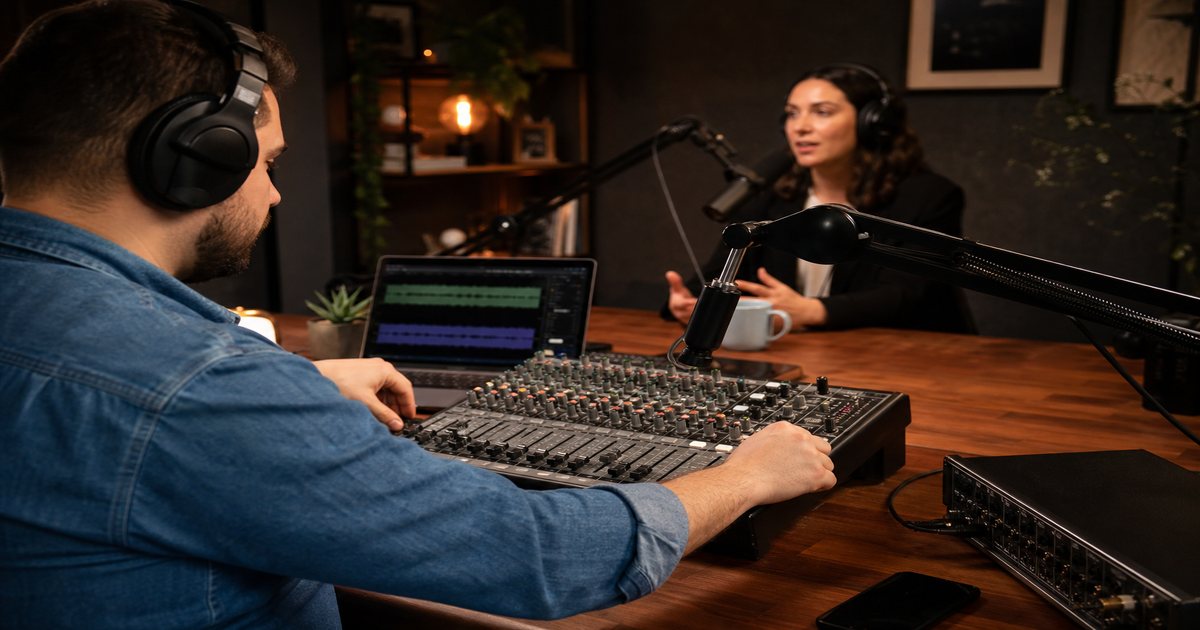
Sponsor segments live or die on trust. Aggressive stingers signal infomercial; silence signals amateur. The right royalty-free bed from FreeBeatHub frames the offer, separates ads from editorial content, and keeps networks happy with documented clearance.
Anatomy of a Sponsor Segment
Strong sponsor blocks follow enter → read → CTA → exit. Music marks each phase: soft swell on enter, ducked bed under read, resolve on exit back to show content.
Pre-produce enter and exit stingers as reusable assets so dynamically inserted ads share consistent sonic boundaries.
Music That Builds Trust, Not Hype
Financial, health, and B2B sponsors need neutral corporate or light acoustic beds. Consumer lifestyle brands can tolerate slightly higher energy—still instrumental under the read.

Enter and Exit Transitions
Fade beds in over 1–2 seconds—never hard-start under mid-sentence hosts. Exit with a complementary sting or fade matching your show's intro motif at lower energy.
Listeners forgive long ads; they do not forgive jarring ones.
Ducking Under Host Reads
Apply the same ducking rules as background beds but allow beds to sit 2–4 dB louder during pauses between talking points—creates rhythm without masking words.
Dynamic Ad Insertion Considerations
DAI systems swap ad content without your manual edit. Standardize bed levels and stinger files so inserted reads always match loudness specs. Document LUFS targets for network QA.
- Separate bed and stinger files for DAI assembly
- Target -16 to -18 LUFS integrated on ad blocks
- Avoid beds with tempo changes mid-loop
- Store license IDs in ad ops documentation
Sponsor Music Playbook
Maintain enter stinger, neutral bed, exit resolve, and optional CTA bump. Map sponsor categories to bed choices in a one-page playbook shared with producers. Review licensing before network syndication.

Key Takeaways
- Structure sponsor blocks as enter → read → CTA → exit
- Use neutral trust-forward beds for most sponsor categories
- Fade transitions over 1–2 seconds—never hard-start beds
- Standardize loudness for dynamic ad insertion networks
- Document cleared beds in ad ops and license archives
| Sponsor Type | Bed Mood | Enter Style | Exit Style |
|---|---|---|---|
| SaaS / B2B | Corporate neutral | Soft swell | Resolved chord |
| Finance | Minimal ambient | Gentle fade | Silence to content |
| Consumer brand | Light pop instrumental | Stinger + bed | Branded motif tail |
| Affiliate offer | Warm acoustic | 1s fade in | Fade to show bed |
Ready to find your soundtrack? Browse thousands of royalty-free tracks on FreeBeatHub.
Browse Free MusicFrequently Asked Questions
Should sponsor music differ from episode intro music?
Yes. Sponsor beds should feel neutral and trustworthy—distinct from your branded intro sting so listeners recognize the commercial boundary.
Can sponsors provide their own music?
Only if they transfer commercial rights for podcast distribution. Default to your pre-cleared library to avoid network rejections.
How long should sponsor beds run?
Typically 30–90 seconds total including enter, read, and exit. Beds should loop cleanly if reads vary in length.
Does music affect ad conversion?
Neutral underscore can increase completion rate; hype music often decreases trust on financial and SaaS offers.